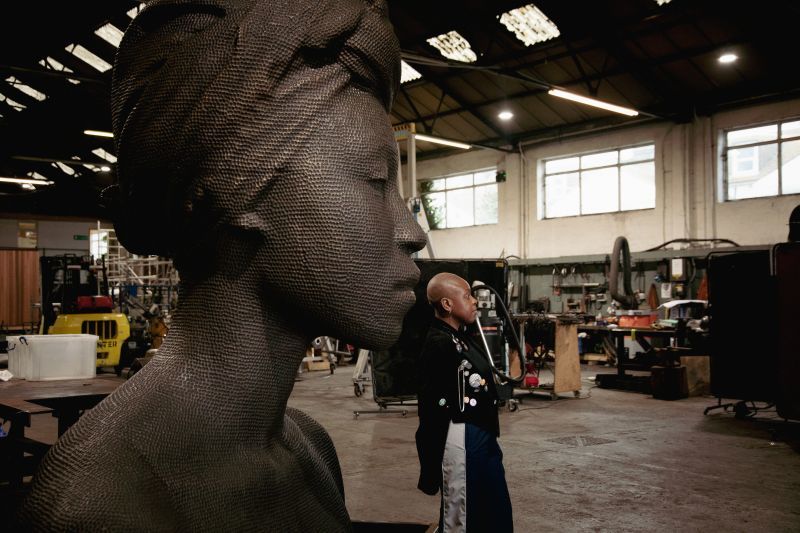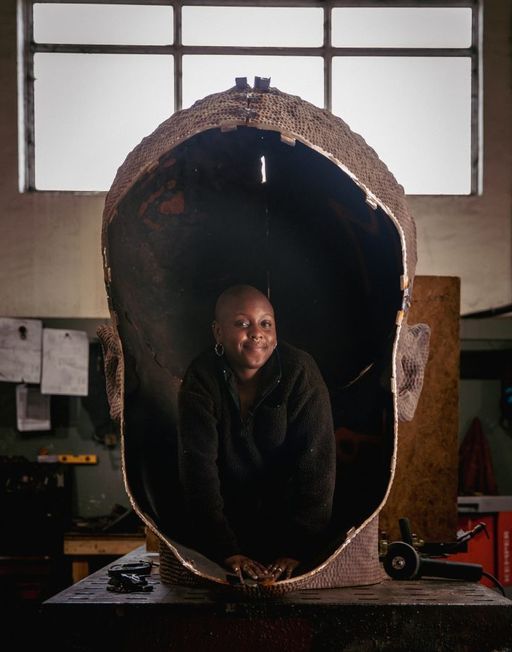
The Black Renaissance sculptures began not in a foundry, but in the intersection between history, digital technology, and one artist's determination to represent the unrepresented.
Rayvenn Shaleigha D'Clark
Rayvenn Shaleigha D'Clark is a British sculptor whose practice combines digital and traditional methods. Her work is concerned with representation, identity, and the public landscape: who gets to be depicted in permanent material, and what that tells us about whose stories a society considers worth preserving.
For the Black Renaissance commission, D'Clark was given the brief to create five monumental figures representing anonymous individuals whose histories are part of the story the Freedom Monument Sculpture Park tells. She brought to the commission a process that is both technically sophisticated and deeply human.
From Research to Digital Model
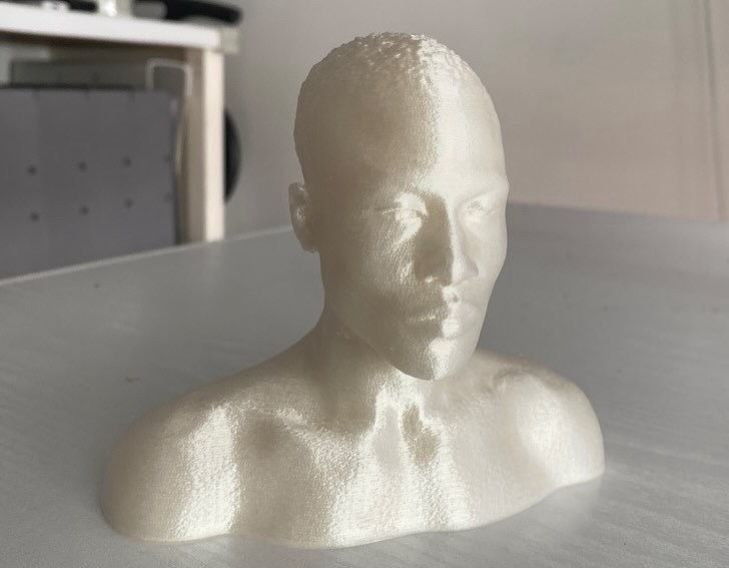
D'Clark's starting point was research: into the lives, the culture, and the visual language of the communities the sculptures would represent. From that research, she developed digital models using professional sculpting software, working at a level of surface detail that was extraordinarily demanding.
The surfaces of the Black Renaissance sculptures carry fine physiological and cultural detail: features, textures, and references that had to be present in the final bronze for the work to be what it needed to be. Some of this detail pushed the software to its limits. Where the digital tools could not fully resolve what D'Clark needed, physical intervention, sketching, and dialogue between the artist and our casting team filled the gap.
The Foundry Conversation
What made this project work was not just the technology. It was the conversation between the artist and the foundry. D'Clark understood that a casting has its own constraints: minimum wall thicknesses, draft angles, the way metal flows and solidifies. Our team understood that a work of art has its own non-negotiable requirements.
The result of that conversation was a casting approach that used 3D printed sand moulds produced directly from D'Clark's digital files. This allowed us to preserve the surface detail that the artist had worked to create, without the compromise that conventional pattern tooling would have forced.
52 Unique Castings
Each of the five sculptures was cast in multiple segments: 52 unique castings in total, each from its own 3D printed mould. No two moulds were identical. The assembly of those segments into the finished sculptures was carried out by Millimetre, West Sussex, whose fabrication skill was as important to the final result as the casting.
Seeing the completed sculptures installed at the Freedom Monument Sculpture Park is, for everyone who worked on this project, a reminder of what the trade of casting is capable of when it is placed in service of something worth making.