
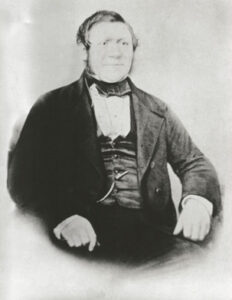
Primary research by Grahame Hood. Additional documentary research by Chris Jones.
Many thanks to Chris Jones, who has done so much to check documents and establish the facts about the remarkable Mr England, though a fair bit of speculation still has to be done.
Origins and early life
The Dictionary of National Biography gives the birth date of George England as 1811 in Newcastle upon Tyne. The previously accepted account was that by the age of 14 he had moved to London to begin an engineering apprenticeship with John Penn and Sons in Greenwich, noted manufacturers of marine steam engines.
Research has identified a George England, married to a Mary Whinney in 1808, whose son George was born on 8th July 1811. Records show four other children: Eliza (1809), Isabella (1813), Anne (1814) and Mary (1816). In July 1832, a George England appeared in the papers for accidentally killing his wife Mary in Swalwell, in the Whickham district of Newcastle upon Tyne, with their daughter Isabella as a witness. The juxtaposition of these names so close to Newcastle makes it almost certain that this was the family George England was born into, although it cannot be absolutely proved.
Chris Jones has speculated that England may not have served a formal apprenticeship at all. Apprenticeships were expensive, and a strong young man with a basic knowledge of blacksmith work would have found employment easily enough. He could have travelled to London by cargo or passenger ship, which regularly ran cheaply up and down the East Coast.
A relative, Henry England, owned land in Peckham Lane and in Kender Street, South London, and George certainly knew him. It is possible that Henry arranged George's early employment and may have provided accommodation.
First marriage and early career
George England first appears in London records on his marriage to Jane Dafter from Wiltshire, at St Clement Dane's church on 28th July 1834. A court case from January 1838, in which Jane had a shawl stolen, confirms he was then living in the Edgeware Road area. There are hints the marriage was not a success: she had spent Christmas 1837 with friends in Greenwich rather than with her husband.
In 1839, England appears in Pigot's Directory with an address at 27 Gloucester Terrace, Vauxhall Bridge Road, giving his profession as Smith. On 30th April 1839, he appears in the minutes of the London and Southampton Railway as being paid for the supply of tools.
The marriage did not last. He left Jane to live with Sarah Hannar, of the same age, with whom he had three children: Mary, born 1841; Eliza Anne, born 1843; and George Junior, born 1844. When his first wife died, he married Sarah. The 1861 census records her as his wife.
The Hatcham Iron Works
By 1839, England had begun renting a vacant factory building on a piece of land between Pomeroy Street and Kender Street, just off the Old Kent Road, in the then semi-rural district of Hatcham, now better known as New Cross. The premises consisted of a cottage, where the family lived, and a manufactory. They had previously been occupied by Henry Duxbury, who was involved in the leather trade.
England took out Patent No. 8058 on 7th May 1839 for a design of screw jack, and Patent No. 8860 on 2nd March 1841 for a machine for weaving woollens. These inventions made him successful enough to purchase the factory, which he renamed The Hatcham Iron Works. The 1846 edition of the Post Office Directories lists him as: England, George and Co. Engineers and patent screw jack manufacturers, Hatcham Iron Works, Old Kent Road.
He was already interested in railway engineering, having sold tools to the London and Southampton Railway in 1839, and in 1843 had tried out his manumotive railway carriage on the London and Croydon Railway. He began building locomotives, selling his first in 1849. His locomotive Little England was at the Great Exhibition of 1851 and was awarded a gold medal. His locomotives sold in the UK, Europe, India, and Australia.
The factory was extended in 1853, being largely occupied at that time in making castings for the Crystal Palace. A further, larger extension was added to the buildings in Pomeroy Street in 1861/2, this time on the north side of the original works. At the rear of the new works was a piece of land used to lay an oval of standard gauge track for testing locomotives in steam.
By 1861, the factory had expanded twice. In 1858 England built Hatcham Lodge for his family and three servants, and a row of houses in Kender Street called Georgina Terrace, to house his workmen.
Character and reputation
England was known as an autocrat. The railway historian C. Hamilton Ellis wrote of him:
“George England, who was an industrialist and no gentleman... George England was very proud of his little engine (Little England), which was taken to provide the design for his letter headings for several years.”
-
- Hamilton Ellis, The North British Railway, Ian Allan, 2nd Edition, 1959, p.50 et seq.
In November 1858, England was charged with unlawfully assaulting and beating his apprentice, George Effingham Pattie. England's defence was that the apprentice had stolen spanners belonging to his son. The magistrate fined him five shillings and costs, adding that the defendant had been rather too free with his correction.
England was a director of the Crystal Palace Company from 1857. A significant fraud by the registrar William Robson, who defrauded the company of £28,000, caused the other nine directors to ask England to resign. He initially refused, stating that his enemies were using his family affairs as an excuse. He eventually resigned, despite a vote of shareholders urging him to stay.
Robert Fairlie and the elopement
By 1861, a frequent visitor to Hatcham Lodge was Robert Francis Fairlie, an engineer born in Glasgow in 1831. Fairlie had returned to London and was working as a consultant engineer. Though much of the talk between England and Fairlie was of engineering matters, Robert paid considerable attention to Miss Eliza Anne England, known as Lizzie. At 17, George thought Lizzie too young to be courted seriously and asked Fairlie to wait.
In January 1862, Lizzie and her sister went to the Crystal Palace for the day. Only Mary returned. By the time George and Sarah discovered what had happened, the couple had eloped, having gained a marriage licence after Fairlie signed an affidavit claiming to have her father's permission. They were already on the Boat Train. When the couple returned from their honeymoon in Spain, George took Fairlie to court for perjury.
The resulting case at the Central Criminal Court, reported in The Times of 8th April 1862, caused much public interest. Under cross-examination, England was forced to admit that he had run away with his present wife Sarah Hannar, the mother of Eliza, while his first wife was still living. By a quirk of English law at the time, a child born out of wedlock was considered nobody's child: Eliza had no legal relationship to England and could marry whom she pleased. There was no case to answer and a verdict of not guilty was returned. The families were eventually reconciled, possibly when the first grandchild appeared, and Fairlie gradually became involved in England's work.
The 1865 strike and its aftermath
Around 26th January 1865, George England's workforce went on strike. The strike lasted five weeks and proved devastating for the company. England lost a significant order from the South Eastern Railway, losing much of his skilled workforce to other employers. His capable manager, Cleminson, also departed. For a full account of the strike, see the separate archive article The 1865 Strike.
Later years and death
England retired in 1869. The company was taken over by his son, George England Junior, and Francis Fairlie, trading as The Fairlie Engine and Steam Carriage Company. This new company was not successful and when George Junior died in 1870, Fairlie closed the works.
George England Senior died in Cannes, France, in 1878.
Hamilton Ellis: a contemporary assessment
The railway historian C. Hamilton Ellis offered the following characterisation, noting that the company's difficulties arose principally from the 1865 strike:
“The firm fell on evil days in the sixties, chiefly through an engineering strike which cost it some important contracts, and led to its winding up. Sir William Hardman recorded some pungent incidental scandals; that England was much involved with the Crystal Palace, made enemies in connection therewith, and was attacked on moral grounds because he prosecuted for perjury the interesting Mr Fairlie, who had eloped with an illegitimate daughter of his. Fairlie was acquitted and England's swan-song seems to have been building the Fairlie patent locomotive Little Wonder for the Festiniog Railway. A quaint business, truly!”
-
- Hamilton Ellis, The North British Railway, Ian Allan, 2nd Edition, 1959, p.50 et seq.