Primary research by Grahame Hood. Documentary research by C.H. Dickon, SLS Journal, 1961.
Of all the sites to choose for a locomotive works, Pomeroy Street, London SE, seems to be one of the most unlikely.
“Although there was (and still is) a railway about half a mile to the east, and another about a quarter of a mile to the west, there was no physical connection between the works and the line, and all locomotives built at Hatcham Iron Works had to be carted by road, most probably to Bricklayers Arms, although New Cross cannot be entirely ruled out. A partial explanation of this not unique state of affairs in the nineteenth century can be found in the fact that England started out in general engineering and only built locomotives later on.”
C.H. Dickon, SLS Journal, 1961, p.138.
Establishing the site
The late E.L. Ahrons, in his article on George England published in The Engineer of 15th July 1921, stated that the works started about 1843. This has since been revised by documentary evidence. Mr Craven found, in the minutes of the London and Southampton Railway dated 30th April 1839, an entry for a payment to George England for tools. England also took out Patent No. 8058 on 7th May 1839 for a screw jack, and Patent No. 8860 on 2nd March 1841 for a woollen weaving machine.
The Post Office Directories of the period make no reference to England until the 1846 edition, which reads: England, George and Co. Engineers and patent screw jack manufacturers, Hatcham Inn (sic) Works, Old Kent Road. A search of the rate books conducted by the Town Clerk of Deptford shows that George first paid rates on the property in July 1840.
The name Geo England is scribbled in pencil against premises that had been empty for about a year. The property, listed as a House and Manufactory belonging to Henry Duxford, had been occupied by a William Morgan for at least six years.
Henry Duxbury had been in the leather trade. The Post Office Directory of 1823 shows him as a water-proof leather-dresser and leather-hat maker. By 1832, his entry reads: Duxbury, H., Patentee for Splitting Hides and Skins, Pomeroy, Old Kent Street.
Expansion and the test track
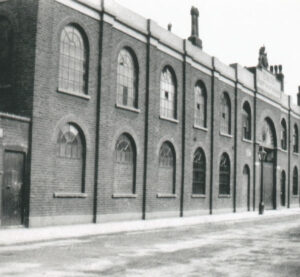
In 1853, the factory was extended, being largely occupied at that time in making castings for the Crystal Palace. In 1861/2 a further, larger extension was added on the north side of the original works in Pomeroy Street. At the rear of the new works was a piece of land nicknamed the cabbage patch, on which was laid an oval of standard gauge track, like a large toy train set. There was a rail connection into the main building and the circle was used to test locomotives in steam.
Moving locomotives to the railhead
One noteworthy aspect of the Hatcham site was that it had no direct access to the main railway system. All finished engines had to be taken by road to the nearest railhead. A. R. Rosling described the method used:
“The transport was managed by means of a heavy lorry mounted on four strong wheels, with very broad tread. Rails were laid on the lorry, and an inclined plane with rails upon it secured to the back so as to make a connection with rails upon the ground. The engine to be taken away was hauled onto the wagon by means of eight horses pulling on the fall of a block and tackle.”
A.R. Rosling, Locomotive Building in London, The Railway Magazine, November 1907.
At New Cross there once existed a siding to the west of the shed but at a lower level, which terminated without permanent buffer stops at the end of Five Bells Lane (later Hatcham Park Road). It was to this siding that some of the locomotives built by George England were brought from his Hatcham Iron Works in Pomeroy Street, to start the journey to their purchaser.
Working conditions for apprentices
“The conditions of employment for apprentices was quoted: they were articled to the firm for seven years, the first three without pay, boys receiving however, one shilling per week for good conduct.”
The Kentish Mercury, 8th November 1858, quoted by C.H. Rickon.
After George England
Following the effects of the 1865 strike, the works were taken over by The Fairlie Engine and Steam Carriage Company. This did not thrive and the works were sold in 1872.
The 1853 building was occupied by the General Engine and Boiler Company from 1873. In the mid-1930s they became Reliance Foundry, who remained until 1981, after which the building was demolished.
The original part of the factory housed the Delta Metal Company, who were succeeded by the Pomeroy Paper Mills and then an automotive engineering shop. The 1862 portion was bought in 1877 by J.C. Eno, of Fruit Salts fame, though they left due to bombing in 1940. After the war the building was used by the pharmaceutical firm of Robert Blackie and Company until 1969, after which it was pulled down to make space for housing.