Black Renaissance
Sculptures
Cast segments
Material
Height
Client
Equal Justice Initiative (EJI)
Fabrication partner
Millimetre, West Sussex
Location
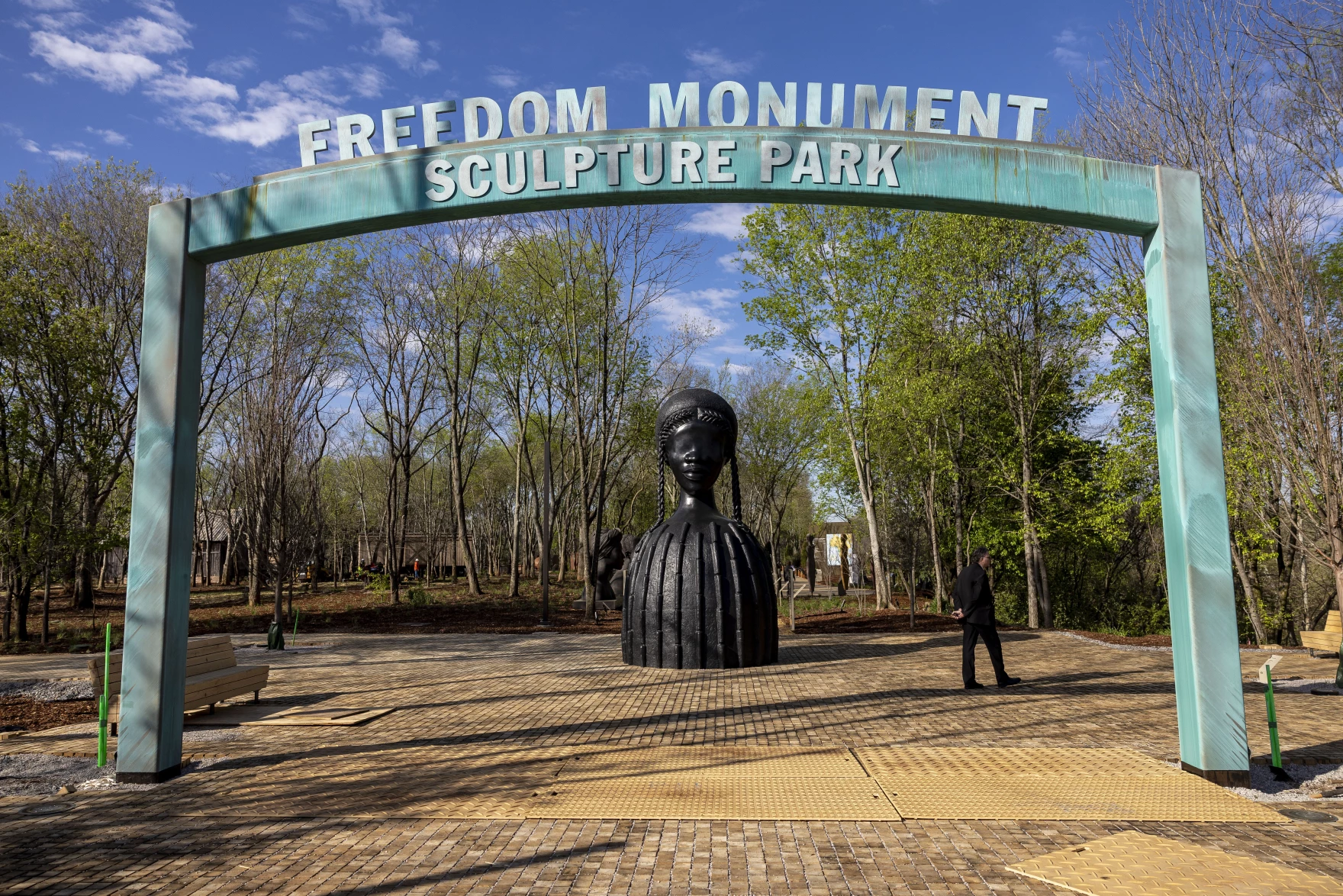
Freedom Monument Sculpture Park, Montgomery, Alabama, USA
Sector
Art Foundry
Services
3D printed sand mould production, silicon bronze sand casting, bespoke running system design, polishing
Status
Installed and on permanent display
Artist
Rayvenn Shaleigha D'Clark
Mould technology
Voxeljet AG 3D printed sand moulds
Award
CMF Component of the Year 2024
The Commission
The Equal Justice Initiative is one of America's foremost civil rights organisations. Its Freedom Monument Sculpture Park, on the banks of the Alabama River, is a 17-acre site dedicated to exploring the lived experience of the millions of Black people enslaved in America, honouring their lives, and celebrating their courage and resilience.
For the park's Black Renaissance series, artist Rayvenn Shaleigha D'Clark conceived five monumental sculptures, each approximately 2.5 metres tall, representing anonymous figures whose histories and contributions have been overlooked. The sculptures were designed not just to be seen but to be encountered physically, with deeply textured surfaces that reward close attention.
Producing them in silicon bronze was not incidental. Bronze is the material of monuments, of permanence, of history given physical form. The choice was deliberate and the execution had to be worthy of it.
The Technical Challenge
D'Clark's vision demanded a level of surface fidelity that conventional sand casting could not deliver. The sculptures featured deep facial dimpling, pronounced undercutting, and complex three-dimensional geometry: precisely the characteristics that cause traditional sand patterns to bond chemically to the mould during extraction, making them prohibitively expensive or simply impossible to produce by conventional means.
The five sculptures would also need to be cast in segments and assembled, requiring each of the 52 individual castings to meet exacting dimensional tolerances so that the assembled pieces would be structurally sound and visually seamless.
Our Solution
Maybrey pioneered the use of 3D printed sand moulds for this project, using Voxeljet AG printing technology to produce moulds directly from D'Clark's digital files. This eliminated the bond problem entirely: printed sand moulds do not chemically adhere to complex undercuts in the way traditional compacted sand patterns do. Each of the 52 unique moulds was produced to the exact geometry of the sculpture segment it would form.
The choice of silicon bronze was critical to the assembly phase. Silicon bronze has exceptional weldability and accommodates variations in wall thickness better than most casting alloys, making it the right material for large-scale work that needs to be cast in sections and welded together without visible joints.
Our team designed a bespoke running and gating system for each segment, using double pours and multiple ingates to control metal flow and prevent blemishes from oxides and gas pockets. The surface quality of the castings had to justify the surface quality of the sculpture: no blemish would be acceptable.
Collaboration and Finishing
Following casting and initial finishing at Aylesford, the 52 segments were passed to Millimetre, an award-winning design and fabrication studio in West Sussex, who polished, assembled, and welded the sculptures into their final form before they were shipped to Alabama for installation at the Freedom Monument Sculpture Park.
The collaboration between Maybrey's casting expertise and Millimetre's fabrication skill was fundamental to the project's success: two specialist disciplines, each operating at the limits of their craft.
The Result
Five monumental silicon bronze sculptures now stand at the Freedom Monument Sculpture Park, forming a permanent part of one of the most significant civil rights sites in the United States. They have been seen by visitors from across the world.
The processes developed during Black Renaissance have also opened up a new category of work for artists: the ability to realise large-scale, complex digital sculpture in bronze at a cost that was previously unreachable. What was pioneered here for one of the most important art commissions of recent years is now available to any artist working at this scale.